




How Schema Markup for AI Search Helps ChatGPT and Google AI Understand Your Content
Why do some websites show up in ChatGPT, Google AI Overviews, and Perplexity answers while others never get mentioned at all? In most cases, the difference comes down to one thing: schema markup. If you want AI search visibility in 2026, structured data is no longer optional — it’s the language machines use to understand your content.
This guide breaks down exactly what schema markup is, why it matters for AI search and answer engine optimization (AEO), and how to implement it the right way.
What Is Schema Markup, in Plain Words?
Schema markup is a form of structured data, added directly to your website’s code, that labels your content in a way search engines and AI models can read instantly. Instead of guessing what a page is about from plain text, a search engine or AI crawler sees clear tags like “this is a recipe,” “this is a product with a price,” or “this is a question with an answer.”
Schema.org is the shared vocabulary behind this system. It was built by Google, Bing, Yahoo, and Yandex, and it’s now the same foundation large language models rely on when they pull facts to answer user queries.
Why Schema Markup Matters More Than Ever Right Now
Traditional SEO focused on ranking a blue link on page one. AI search visibility is different. Tools like Google’s AI Overviews, ChatGPT search, and Perplexity don’t rank links — they extract and synthesize answers. That means your content needs to be structured well enough for an AI model to lift a clean fact, quote, or definition out of it with confidence.
Here’s what well-implemented schema markup does for you:
- Improves machine readability — AI crawlers parse structured facts faster than unstructured paragraphs
- Increases chances of being cited as a source in AI-generated answers
- Boosts rich results in traditional search (star ratings, FAQs, breadcrumbs)
- Builds topical trust signals that connect your content to established entities
- Reduces ambiguity around dates, prices, authors, and other key facts
In short, schema markup is one of the highest-leverage, lowest-effort tactics for both SEO and AEO right now.

5 Schema Types That Matter Most for AI Search
Not all schema types carry equal weight for AI search. If you’re prioritizing, start here:
1. FAQs Page Schema
This is the backbone of answer engine optimization. It structures a direct question and a direct answer, which is exactly the format AI models prefer to extract and reuse. If your blog answers common questions, FAQs Page schema should be non-negotiable.
2. Article / Blog Posting Schema
This tells search engines the headline, author, publish date, and main content of a post. It establishes authorship and freshness — two things AI models weigh when deciding whether to trust a source.
3. How To Schema
Perfect for step-by-step guides. It breaks content into clear, sequential steps that AI tools can summarize accurately without misrepresenting your process.
4. Organization and Person Schema
These establish who is behind the content. AI models increasingly favor content with clear, verifiable authorship over anonymous or unclear sources — this is a core part of E-E-A-T (Experience, Expertise, Authoritativeness, Trust).
5. Breadcrumb List Schema
This clarifies site structure and content hierarchy, helping both search engines and AI crawlers understand where a page fits within your broader site.
How to Add Schema Markup for AI search Step by Step
You don’t need to be a developer to implement structured data correctly. Here’s the simplest path:
Step 1: Choose the right schema type Match the schema to your content. A recipe blog needs Recipe schema. A service business needs Local Business schema. Don’t force-fit the wrong type.
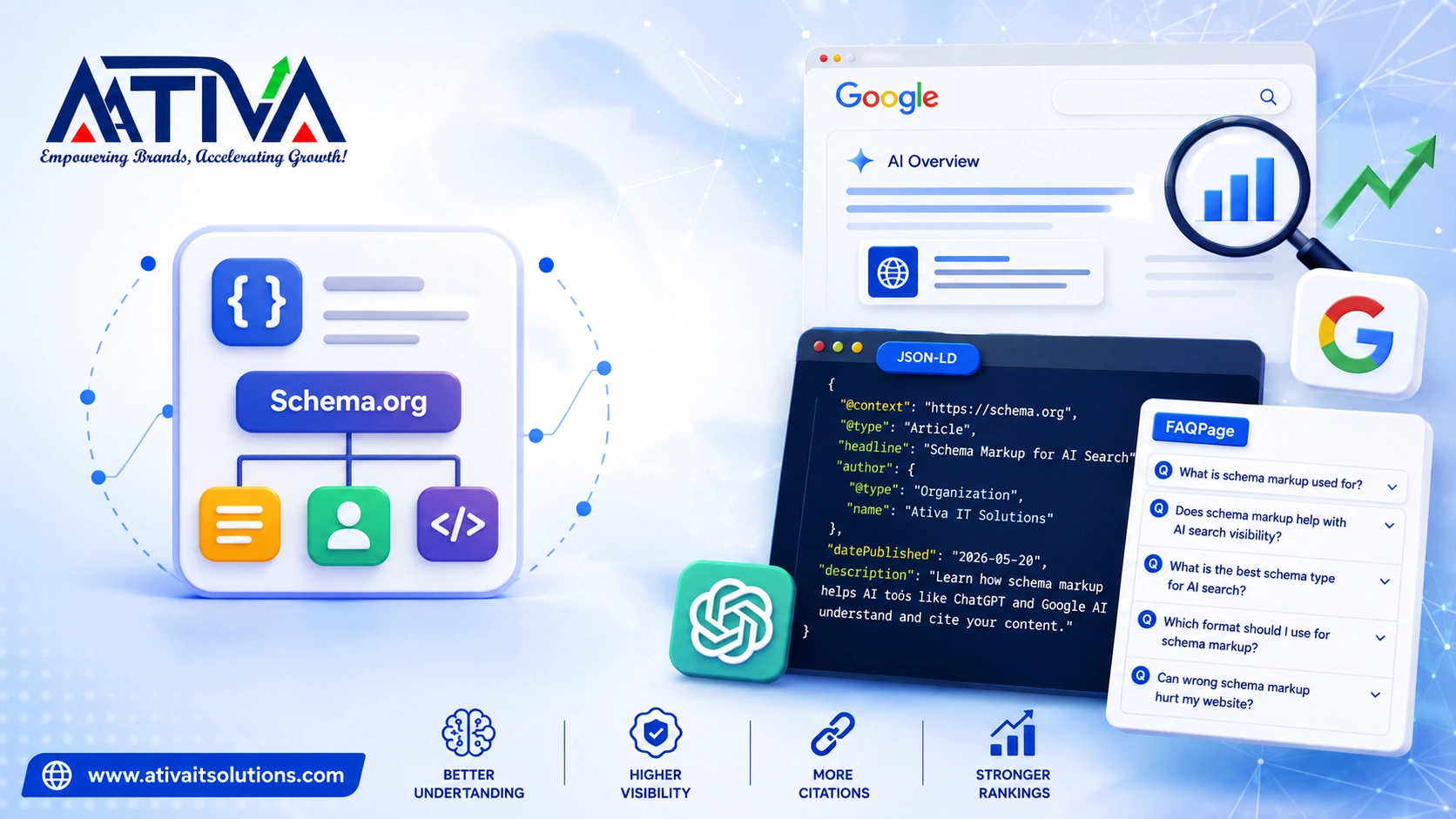
Step 2: Use JSON-LD format Google explicitly recommends JSON-LD over microdata or RDF a because it’s cleaner, easier to maintain, and doesn’t interfere with your page’s visible content. It’s added as a script block in your HTML.
Step 3: Test before publishing Use Google’s Rich Results Test and the Schema Markup Validator to confirm your code is error-free and eligible for enhanced results.
Step 4: Keep it accurate Never mark up content that isn’t actually on the page. Mismatched or misleading schema can get your site penalized rather than boosted.
Step 5: Monitor performance Track impressions and clicks through Google Search Console’s Enhancements report to see which schema types are driving visibility.
Common Schema Markup Mistakes to Avoid
Even experienced site owners get this wrong. Watch out for:
- Adding schema for content that doesn’t exist on the page (a major trust violation)
- Using outdated schema properties that Schema.org has deprecated
- Skipping validation and publishing broken JSON-LD
- Overloading a single page with unrelated schema types
- Ignoring mobile rendering, where structured data can behave differently
Where Schema Markup Is Headed Next
As AI search continues to replace traditional keyword-based queries with conversational, question-based ones, schema markup becomes the connective tissue between your content and the answer engines pulling from it. Sites that treat structured data as an afterthought will struggle to compete with those treating it as core infrastructure.
If you’re building a long-term content or SEO strategy, schema markup deserves the same priority as keyword research and backlink building. It’s not a technical checkbox — it’s how you make sure AI systems understand, trust, and ultimately cite your content.
Why Schema Markup for AI Search Is Essential for Future SEO
Schema markup is one of the most underrated levers for AI search visibility. It won’t replace strong content, but it does make strong content discoverable, extractable, and citable by the systems shaping how people find information today. Start with FAQs Page and Article schema, validate everything you implement, and keep expanding your structured data footprint as your content grows.
Get this foundation right, and you’re not just optimizing for search engines anymore — you’re optimizing for the AI models that are quickly becoming the front door to the internet.
Schema Markup for AI Search FAQs
1. What is schema markup used for?
Schema markup labels your website content with structured data so search engines and AI models can read, understand, and cite it accurately.
2. Does schema markup help with AI search visibility?
Yes. Structured data makes it easier for AI search tools like ChatGPT and Google AI Overviews to extract clean facts and cite your content as a source.
3. What is the best schema type for AI search?
FAQs Page, Article, and How To schema work best because they match the question-and-answer format AI models prefer to pull from.
4. Which format should I use for schema markup?
JSON-LD is the recommended format, since Google and most AI crawlers read it more reliably than microdata or RDFa.
5. Can wrong schema markup hurt my website?
Yes. Marking up content that isn’t actually on the page can hurt trust signals and may lead to search penalties instead of visibility gains.