
What is E-E-A-T in SEO? Improve Trust, Rankings & Traffic
You did the keyword research. You published the blog. You even built a few backlinks. But Google still won’t rank your page — or worse, you dropped after the last core update.
The problem? It’s probably not your keywords. It’s your E-E-A-T signals.
If you’ve been asking yourself what is E-E-A-T in SEO and why it keeps coming up in every SEO conversation in 2026 — this guide breaks it all down in plain language, with practical steps you can apply to your ecommerce brand today.
So, What is E-E-A-T in SEO?
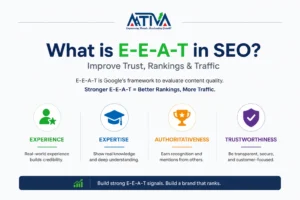
E-E-A-T stands for Experience, Expertise, Authoritativeness, and Trustworthiness. It’s Google’s quality framework — a set of signals Google uses to decide whether your content is genuinely helpful and credible, or just another page trying to game the algorithm.
Google first introduced E-A-T in its Search Quality Rater Guidelines. In December 2022, they added the extra “E” for Experience — because being an expert on paper isn’t the same as actually having done the thing you’re writing about.
By 2026, E-E-A-T is no longer just a buzzword. After Google’s December 2025 Core Update, sites relying on thin AI content, keyword stuffing, or generic product descriptions saw serious ranking drops. Brands with real credibility, real authors, and real depth? They came out stronger.
Quick fact- E-E-A-T is not a direct ranking factor — there’s no single score. It’s a collection of signals. But those signals now influence rankings across every industry, including ecommerce, health, finance, and SaaS.
Breaking Down the Four Pillars
1. Experience — Have You Actually Done It?
This is the newest pillar and the most misunderstood. Experience means first-hand, lived knowledge.
A nutritionist writing about protein supplements = Expertise. A brand that has tested 15 formulas, tracked 2,000 customer results, and shares real data = Experience.
For ecommerce brands, this shows up as: real product testing, customer case studies, before/after results, and founder stories. Stop hiding behind corporate copy — Google wants to see that a real person with real knowledge is behind your content.
2. Expertise — Do You Actually Know Your Subject?
Expertise is demonstrated depth. It’s not just mentioning a topic — it’s going deep enough that a reader (and Google) can tell you genuinely understand it.
On your product pages and blogs, this means:
- Named authors with credentials and bios
- Accurate, detailed product information (not vague marketing fluff)
- Content that answers the why, not just the what
A simple fix: add a proper author bio to every blog post. Name, title, years of experience, area of expertise. That alone is a strong expertise signal for SEO.
3. Authoritativeness — What Do Others Say About You?
Authority isn’t what you say about yourself — it’s what others say about you.
This pillar is built through:
- Quality backlinks from relevant industry websites
- Press mentions, podcast features, and media coverage
- Third-party reviews on Google, Trustpilot, Amazon, and Walmart
- Brand citations across the web
You can’t fake authoritativeness. You earn it by publishing content that other sites find worth referencing, and by operating a brand that people genuinely talk about.
4. Trustworthiness — Can People Trust You?
Trust is the foundation everything else sits on. According to Google’s own guidelines, a page that lacks trust cannot rank well, no matter how expert or authoritative it seems.
For ecommerce brands, trust signals include:
- HTTPS/SSL (non-negotiable in 2026)
- Clear refund, privacy, and shipping policies — easy to find
- Real contact information: phone, email, physical address
- Verified customer reviews — volume and recency matter
- No misleading claims or hidden fees
- Security badges at checkout
If someone lands on your site and can’t quickly figure out who you are and why they should trust you, that’s an E-E-A-T problem.
Why E-E-A-T Matters More for Ecommerce in 2026
Here’s what most ecommerce sellers get wrong — they think E-E-A-T only applies to blogs and long-form content.
It doesn’t. It applies to every page on your site.
- Product pages need verified reviews, accurate specs, honest descriptions, and clear brand identity. A product page with zero reviews and a generic two-line description is a trust and authority gap.
- Category pages need a short expert introduction — 100 to 150 words explaining what to look for, why your products stand out, and who they’re for. Most brands skip this entirely.
- Your About page is one of the highest-impact E-E-A-T pages on your whole site. It should tell your brand story, show your team’s credentials, and explain why you’re qualified to sell what you sell. A thin About page is a missed opportunity every single day.
E-E-A-T on Amazon and Walmart — Yes, It Applies There Too
Amazon’s A10 algorithm and Walmart’s search ranking don’t use Google’s E-E-A-T framework directly. But the same underlying principles drive rankings on both platforms.
- On Amazon: verified reviews = trust, A+ Content = expertise signal, Brand Registry = authority, strong seller metrics = trustworthiness. A listing with detailed A+ Content, 500+ reviews, and consistent brand identity outperforms a thin listing every time — because it signals credibility to both the algorithm and the shopper.
- On Walmart: item quality score rewards content depth and accuracy. Review volume and recency carry serious weight. Brand consistency across title, bullet points, and images builds both platform trust and Google trust when your Walmart page ranks in organic search.
- The compound effect: When someone Googles your brand and sees your website, your Amazon listing, and your Walmart page all appearing — each with high-quality, consistent information — that entire presence is an E-E-A-T signal to Google. You look like a real, established brand with authority across the web.
In 2026, Google is better than ever at telling the difference between a brand that genuinely knows its space and content that just looks the part. E-E-A-T optimization is not a technical trick — it’s about being a real, credible, trustworthy brand and making that visible.
For ecommerce brands on Amazon and Walmart, you already have the experience, the products, and the customer proof. The job is to make all of that visible — on your website, in your content, and across every platform where your brand appears.
That’s exactly what we help brands do at Ativa IT Solutions.