




Moving Company SEO for US Movers
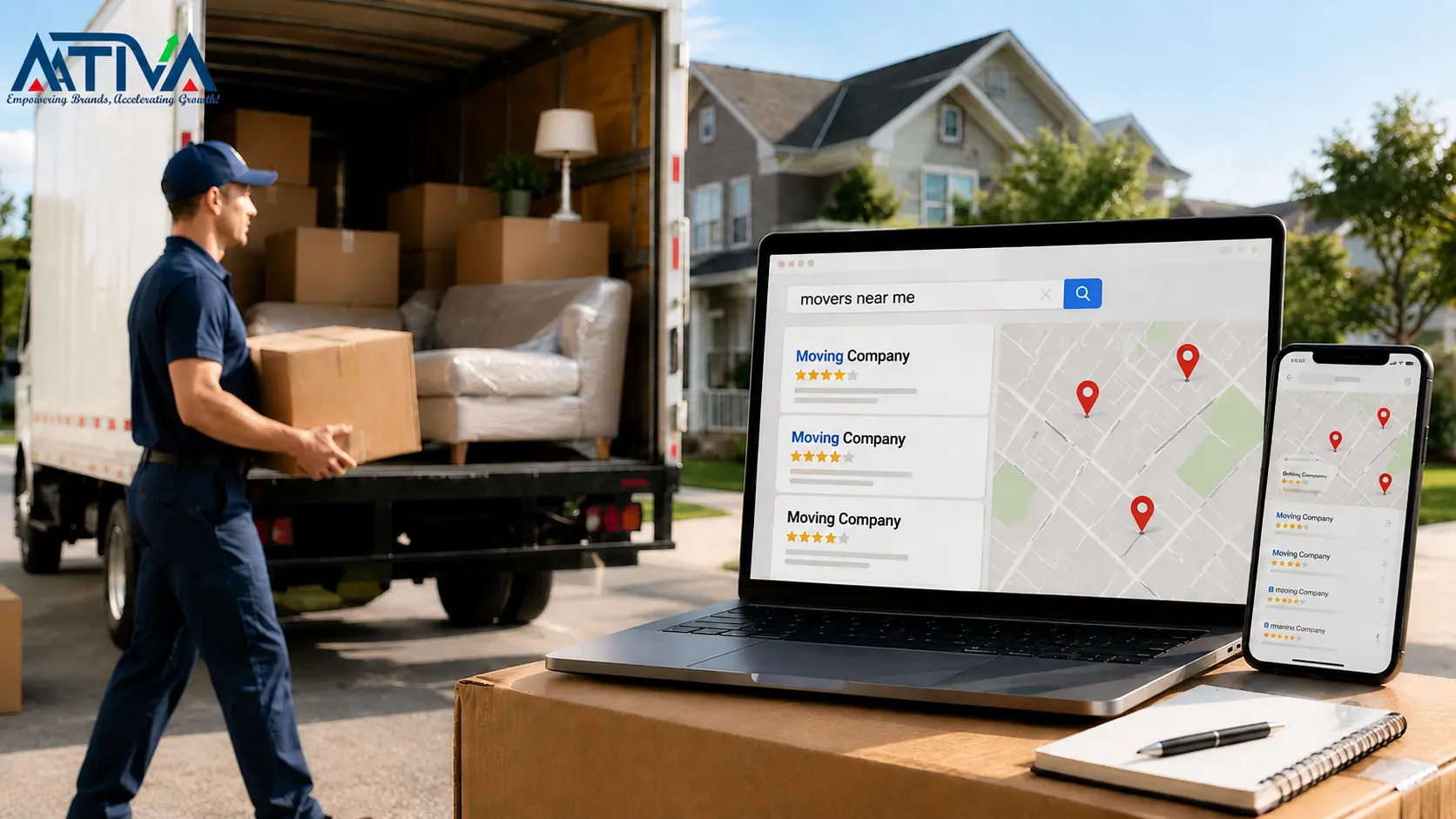
Ask any mover where their jobs come from and you’ll hear the same thing: the phone rings when someone types “movers near me” into Google and picks from whatever shows up first. That’s the whole game. Moving company SEO isn’t a side project you hand off to whoever’s free — it’s the difference between being the company that gets chosen and the one that gets scrolled past.
What makes this industry different from most local businesses is how little loyalty is built in. A family might use the same dentist for a decade, but movers get hired once every few years, sometimes once ever. Every job is a cold search. So the companies that consistently rank aren’t necessarily the biggest — they’re the ones that treated their online presence like an asset instead of an afterthought.
The Map Pack Is Where Jobs Are Won or Lost
Open Google on a phone, search “movers in [any city],” and the first thing that loads isn’t a list of websites — it’s a map with three pinned businesses. Most people never scroll past that. If your company isn’t one of the three names in that box, you’re relying on someone scrolling further, which happens less and less every year.
Getting into that box starts with a fully built-out Google Business Profile: real photos of your trucks and crews (not stock images), accurate service categories, correct hours, and — critically — a steady flow of recent reviews. Google weighs recency almost as heavily as star rating. A company with 40 reviews from two years ago can lose ground to a newer competitor with 15 reviews from the last month.
One Page Per City, Not One Page for Everywhere
A lot of moving companies build a single “Service Areas” page listing twelve cities in a bullet list and call it done. That page rarely ranks for anything, because it doesn’t actually say anything specific about any of those twelve places.
What works instead is giving each major city or metro its own page — its own URL, its own content, written like someone who actually knows the neighborhoods, the parking permit rules downtown, the high-rise buildings with tricky loading docks. A page for long-distance movers heading out of Denver should read completely differently than a page for local movers in Boston. Copy-pasting the same paragraph and swapping the city name is easy to spot, both for readers and for Google — and it tends to hurt the whole site rather than just that one page.
Content That Does the Convincing Before the Call
Not every visitor is ready to book. Plenty are still in the “how much is this going to cost” or “what should I pack myself” stage, searching things like moving cost estimates, packing timelines, or what movers won’t transport. These searches have real volume, and answering them well — clearly, specifically, without padding — builds the kind of trust that turns a random visitor into someone who calls you two weeks later when they’re actually ready.
This is also where a company’s voice matters more than people expect. Generic advice that could apply to any mover in any state reads as filler. Specifics — actual price ranges for actual routes, real seasonal patterns in your region, the particular headaches of moving in your climate — are what make content worth reading and worth ranking.
Reviews, Speed, and the Small Things That Add Up
Site speed and mobile usability rarely get discussed, but they quietly decide a lot of outcomes. Someone comparing four movers on their phone won’t wait for a slow quote form to load — they’ll just tap the next result. Click-to-call buttons, short forms, and pages that load in under two seconds aren’t nice-to-haves; they’re the difference between a lead and a bounce.
Reviews deserve the same attention. Asking for one right after a move goes well — while the relief and gratitude are still fresh — gets far better results than a generic email sent a week later. Responding to every review, especially the negative ones, signals to both future customers and to Google that the business is active and accountable.

Knowing What’s Actually Working
None of this matters much without tracking. Google Analytics shows whether visitors are filling out quote forms or leaving immediately. Search Console shows which specific searches are actually bringing people to the site, which is often surprising — sometimes it’s not the keyword you’d expect. And the Google Business Profile dashboard tracks calls, direction requests, and profile views directly, which is often the clearest signal of all, since those are people who were already close to booking.
Moving company SEO isn’t one trick that unlocks rankings overnight. It’s a handful of fundamentals — a profile that’s actually complete, pages built for real places instead of a list of names, content that answers real questions, and a steady stream of genuine reviews — done consistently, month after month, while competitors are still treating it as a one-time task.
FAQs- About Moving Company SEO
How long does moving company SEO take to show results?
Most companies start seeing movement — pun intended — within 60 to 90 days of cleaning up their Google Business Profile and fixing basic on-site issues. Full local pack rankings in competitive metros usually take four to six months of consistent work, not a single overhaul.
Is SEO better than paid ads for a moving company?
They solve different problems. Paid ads bring calls this week but stop the moment you stop paying. SEO takes longer to build but keeps bringing leads without a per-click cost once you’re ranking. Most established moving companies run both — ads for immediate volume, SEO for the leads that don’t disappear when the budget runs out.
How much should a moving company budget for SEO?
It varies a lot by market size and competition. A single-location mover in a mid-size city might spend a few hundred dollars a month on tools and content; a multi-branch operation competing in Dallas, Chicago, or LA is often looking at a few thousand a month for an agency or in-house effort. The bigger factor isn’t the budget — it’s whether the work actually happens every month instead of in bursts.
Do I need a separate page for every city I serve, or is one service-area page enough?
One generic page rarely ranks for more than your home city, if that. If a city brings in real job volume, it earns its own page with real detail about that market. If it’s an occasional job outside your core area, a mention on a broader regional page is fine — you don’t need fifty thin pages for towns you rarely work in.
Do online reviews actually affect Google rankings, or do they just influence customers?
Both. Review count, average rating, and how recently reviews came in are direct inputs into how Google ranks local businesses in the map pack — separate from how much they sway a person reading them before calling.
What’s the biggest SEO mistake moving companies make?
Treating it as a one-time setup instead of an ongoing habit. A company builds a nice Google Business Profile, writes a few city pages, gets a rush of reviews after launch — then goes quiet for a year. Rankings built that way tend to slide right back down, because competitors who kept working past month two eventually pass them.