Local SEO for Auto Repair Shops- The 2026 Fix for Mechanics Losing Customers to Google Maps
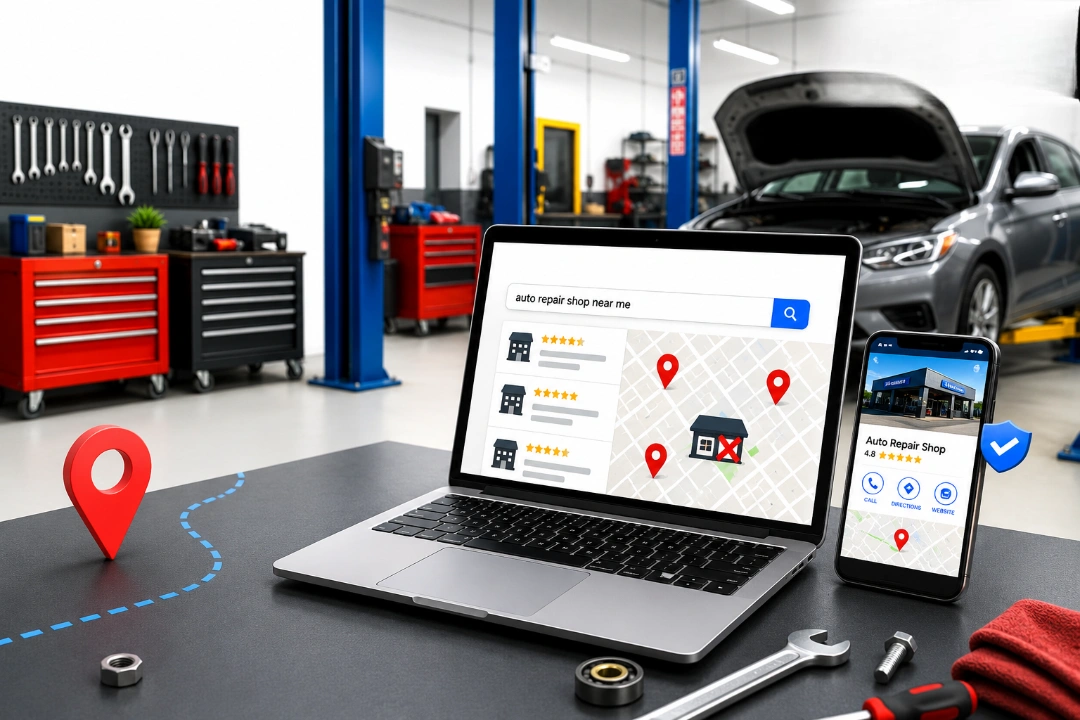
Someone’s car broke down two miles from your shop this morning. They Googled “auto repair shop near me.” Three businesses showed up on that map. Yours wasn’t one of them.
That’s not bad luck. That’s a fixable problem.
In 2026, local search has gotten more competitive — but the shops that understand even the basics of local SEO are still pulling way ahead of everyone else. Most auto repair shops in America are running on word-of-mouth and hope. That leaves a massive gap you can walk right into.
Here’s what actually moves the needle.
Your Google Business Profile Is Either Working or Costing You Money
There’s no middle ground here. Your Google Business Profile (GBP) is the #1 factor in whether you appear in that three-pack map result. And for most shops, it’s either incomplete, outdated, or claimed by nobody at all.
Go to business.google.com right now. If you haven’t claimed your listing, do it today. If you have — check when you last touched it.
The parts most shops skip-
Services section-
Google lets you list every service you offer — oil changes, brake repair, transmission service, AC recharge, wheel alignment, engine diagnostics. Most shop owners ignore this entirely. Every service you add is another search term Google can match you to.
Secondary categories-
Your primary category should be “Auto Repair Shop.” But add secondaries: “Brake Shop,” “Oil Change Service,” “Tire Shop,” “Transmission Shop.” These matter more than most people realize for showing up on specific searches.
Photos-
Businesses with 100+ photos get significantly more direction requests and calls than those with fewer. Shoot your bays, your team, your equipment, your exterior. It takes 20 minutes and it works.
Posts-
Google rewards active profiles. Two posts a month — a seasonal reminder, a current special, a quick tip — signals that your business is alive and engaged.
One thing that’ll get your listing suspended fast: stuffing keywords into your business name on GBP. “Joe’s Auto Repair – Best Oil Change Cheap Brakes” is a violation. Use your real name, exactly as it appears on your storefront.
Reviews Are the Closest Thing to a Cheat Code in Local SEO
When someone is choosing between two mechanics on Google Maps, they’re looking at two things: star rating and number of reviews. That’s it. Price, website, everything else is secondary.
Google’s algorithm weighs this the same way. More reviews, higher rating, recent activity — all of it pushes you up in the local pack rankings.
The best time to ask for a review is the exact moment a customer picks up their car and they’re happy. Right there at the counter:
“Glad we got that sorted for you. If you have two minutes, a Google review would really help us out — I’ll text you the direct link.”
That last part is the whole trick. Texting the direct link removes every excuse. No searching, no navigating, no figuring out how to leave a review. One tap.
Aim for 5–10 new reviews a month. In a year, you’ll have a review profile that most competitors can’t touch.
On negative reviews — respond to every one, calmly, professionally, and invite them to call you. A good response to a 1-star review builds more trust with future readers than the review itself loses.
Citation Consistency Is Boring and It Absolutely Matters
A “citation” is anywhere online your business name, address, and phone number appear. Google cross-references these across the web to verify your business is real and located where you say it is.
The problem isn’t being listed — it’s being listed differently everywhere. “Joe’s Auto Repair” on Google, “Joe’s Auto & Repair Shop” on Yelp, “Joes Automotive” on Yellow Pages — Google treats these as uncertainty signals, not confirmation signals.
The directories that matter most for auto repair shops:
- Yelp
- Apple Maps (massive for iPhone users)
- Bing Places
- Facebook Business Page
- RepairPal
- CarGurus
- BBB
- Nextdoor Business
Google your business name and address. Find every listing. Make sure the name, address, and phone number match exactly — same abbreviations, same suite format, same everything.
Your Website Needs One Thing Above Everything Else: Separate Service Pages
You don’t need a fancy site. You need a functional one Google can understand.
The single highest-impact change most shop websites can make is creating individual pages for each major service instead of cramming everything onto one “Services” page.
One page for oil changes. One for brakes. One for transmission service. One for AC. One for engine diagnostics.
Each page should be 400–500 words, written plainly, with your city name mentioned naturally throughout. “Brake repair in Columbus, Ohio” beats just “brake repair” every time for local searches.
Other non-negotiables-
- Phone number in the header, clickable on mobile
- Google Map embedded on your contact page
- Site loads in under 3 seconds on a phone (check at pagespeed.web.dev)
In 2026, Google’s mobile-first indexing means your site’s mobile performance is what it’s actually ranking. If it loads slow on a phone, you’re losing ground regardless of everything else you do right.
The Keywords You Should Actually Be Targeting
The formula for auto repair keyword targeting is simple:
[Service] + [Your City or “Near Me”]
- “oil change service [your city]”
- “brake repair near me”
- “check engine light diagnostic [your city]”
- “transmission shop [city, state]”
- “wheel alignment [neighborhood]”
But don’t ignore question-based searches. In 2026, Google’s AI Overviews are pulling directly from pages that answer questions clearly and directly. If you add a short FAQ section to each service page — “How do I know my brakes are worn?” “How long does an oil change take?” — you’re competing for that AI-generated visibility too.
Local Backlinks: Easier Than You Think
Google still cares about who links to your website. For local SEO, local links matter most.
The easiest wins for auto repair shops:
- Sponsor a Little League team or local event. Most post sponsor lists on their site with links.
- Join your Chamber of Commerce. Member directories almost always include a website link.
- Partner with nearby non-competing businesses. Body shops, car washes, towing companies — cross-link and refer customers to each other.
You don’t need 100 backlinks. You need 10–15 legitimate local ones to meaningfully move the needle in most mid-size markets.
What To Do First (In Order)
If you’re starting from zero, this is the sequence:
- Claim and fully complete Google Business Profile
- Fix NAP consistency across Yelp, Apple Maps, Bing, and top directories
- Start asking every happy customer for a Google review — this week
- Build individual service pages on your website
- Add your city + service keywords naturally throughout your content
- Post to GBP twice a month, minimum
- Add FAQ content to service pages targeting common customer questions
That’s it. No tricks, no hacks. The shops dominating local search in your city right now are doing these seven things consistently. Most of your competitors aren’t doing even three of them.
The gap is real. And it’s yours to close.