
AI Agents in Marketing- Transforming Online Retail in 2026
AI Agents in Marketing are autonomous, goal-driven software systems that plan, execute, and optimize marketing tasks — like personalization, ad bidding, customer support, and product recommendations — with minimal human input. In 2026, they will reshape eCommerce by enabling real-time hyper-personalization, 24/7 autonomous customer engagement, and self-optimizing ad campaigns, cutting operational costs while boosting conversion rates.
What Are AI Agents in Marketing?
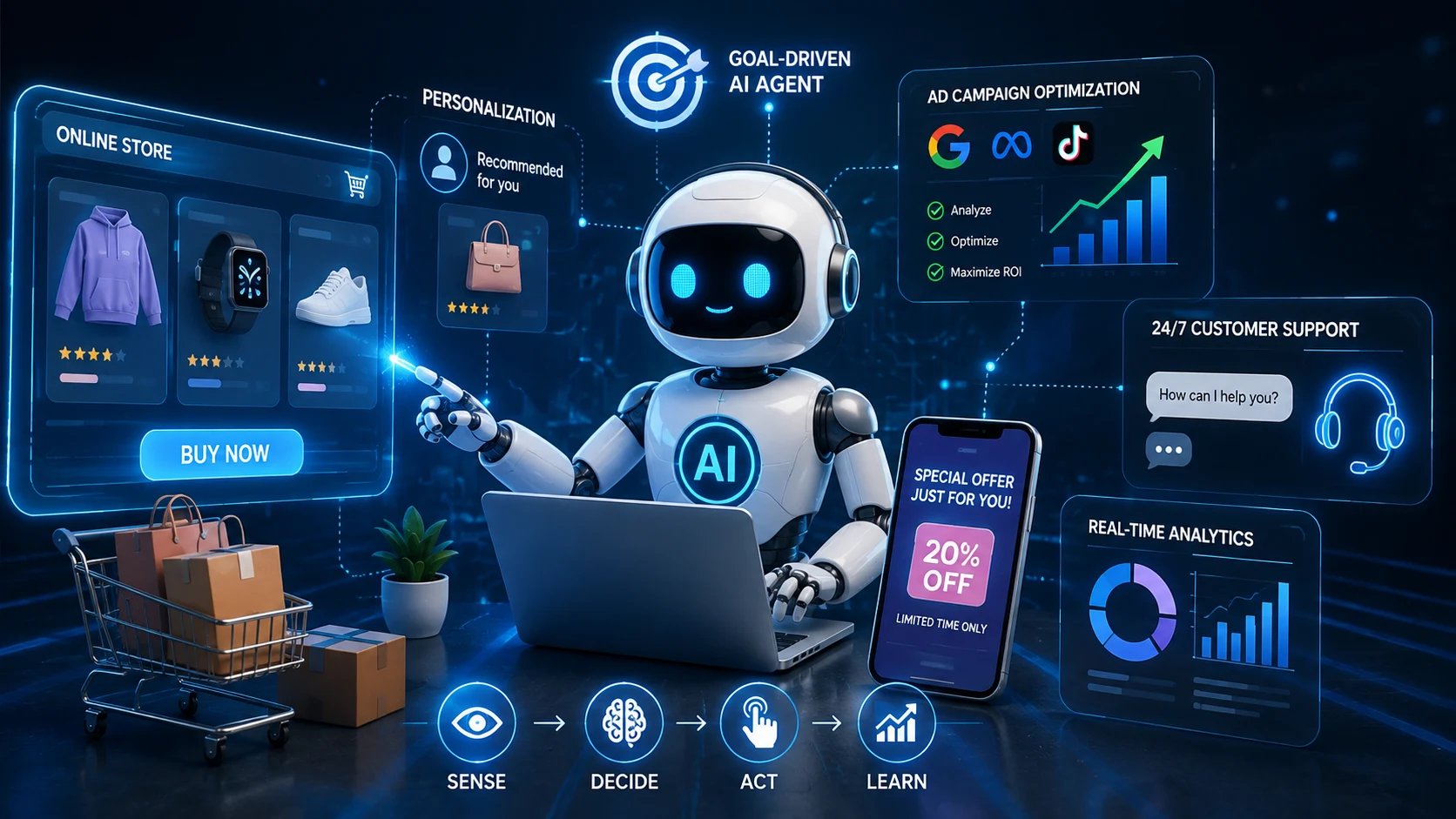
AI Agents in Marketing differ from traditional automation tools or chatbots. A chatbot follows scripted rules. A marketing automation tool triggers predefined workflows. An AI agent, on the other hand, understands a goal, makes decisions, takes actions across multiple systems, and learns from outcomes — all without constant human supervision.
Think of an AI agent as a digital marketing employee that can:
- Analyze customer behavior in real time
- Decide which product, offer, or message fits a specific shopper
- Execute that decision across email, ads, or on-site experience
- Measure results and adjust strategy automatically
This “sense → decide → act → learn” loop is what separates AI Agents in Marketing from earlier generations of martech.
Why AI Agents in Marketing Matter for eCommerce in 2026
eCommerce has always been a data-heavy, high-velocity industry — thousands of SKUs, constant price changes, and shoppers who expect instant relevance. Manual marketing management simply cannot keep pace. This is exactly where AI Agents in Marketing create value.
1. Hyper-Personalization at Scale
Instead of static segments like “returning customers” or “cart abandoners,” AI agents build a live micro-profile for every single shopper. They adjust product recommendations, homepage layout, and even pricing nudges (like limited-time offers) based on real-time signals — browsing speed, scroll depth, past purchases, and even time of day.
2. Autonomous Customer Support and Sales
Conversational AI agents are moving beyond FAQ bots. In 2026, expect agents that can negotiate discounts within set rules, process returns, upsell complementary products, and close sales entirely through chat — functioning like a always-available sales associate.
3. Self-Optimizing Ad Campaigns
AI agents are increasingly used to manage entire paid media budgets. They test creative variations, shift spend across platforms (Google, Meta, TikTok) in real time, and pause underperforming campaigns without waiting for a human to review a weekly report.
4. Predictive Inventory and Demand-Driven Marketing
Marketing agents are starting to talk directly to inventory and supply chain systems. This means promotions can be automatically generated for overstocked items, and marketing pressure can ease off on products approaching stockouts — aligning marketing spend with real business conditions instead of a fixed calendar.
5. Automated Content and Creative Generation
From product descriptions to ad copy and email subject lines, generative AI agents can produce, A/B test, and refine content continuously, keeping messaging fresh without a growing content team.
How AI Agents Will Change eCommerce Operations in 2026
| Traditional eCommerce Marketing | AI-Agent-Driven Marketing (2026) |
|---|---|
| Manual campaign setup | Agents launch and adjust campaigns automatically |
| Static customer segments | Real-time, individual-level personalization |
| Human-reviewed reporting cycles | Continuous self-optimization |
| Rule-based chatbots | Goal-driven conversational agents |
| Scheduled promotions | Demand-triggered, inventory-aware promotions |
This shift doesn’t eliminate marketers — it changes their role. Instead of executing every task manually, marketers will supervise fleets of AI agents, setting strategy, guardrails, and brand voice while the agents handle execution at a speed and scale humans cannot match.
Benefits of AI Agents in Marketing for eCommerce Brands
- Higher conversion rates through individualized shopping journeys
- Lower customer acquisition costs via continuously optimized ad spend
- Reduced support costs with agents handling routine queries and transactions
- Faster time-to-market for campaigns and content
- Better inventory-marketing alignment, reducing markdowns and stockouts
Challenges and Risks to Watch
AI Agents in Marketing bring real advantages, but eCommerce brands should be cautious about:
- Data privacy compliance — agents need access to sensitive behavioral data, raising GDPR/CCPA considerations
- Over-automation risk — agents acting without guardrails can send inconsistent or off-brand messaging
- Integration complexity — agents need clean, connected data across CRM, ad platforms, and inventory systems to work well
- Trust and transparency — customers should know when they’re interacting with an AI agent, especially during sales or support conversations
How to Prepare Your eCommerce Business for AI Agents in Marketing
- Audit your data infrastructure — AI agents are only as good as the data they can access; unify customer, product, and inventory data first.
- Start with a narrow use case — deploy an agent for one task, like abandoned cart recovery or ad bid optimization, before scaling further.
- Set clear guardrails — define brand voice, discount limits, and escalation rules so agents operate within safe boundaries.
- Train your team — marketers should learn to manage and supervise agents, not just execute tasks manually.
- Measure continuously — track how agent-driven campaigns perform against traditional benchmarks to justify further investment.
FAQs – About AI Agents in Marketing
What is the difference between AI agents and chatbots in marketing?
Chatbots follow scripted, rule-based conversations. AI agents in marketing set goals, make autonomous decisions across systems, and learn from outcomes over time.
Will AI agents replace marketing teams in eCommerce?
No — they will shift the marketer’s role from manual execution to strategy, oversight, and guardrail-setting for AI-driven campaigns.
Are AI agents in marketing expensive to implement?
Costs vary by scope. Many eCommerce brands start with a single use case, such as personalized recommendations or ad optimization, before scaling to multi-agent systems.
How soon will AI agents become standard in eCommerce marketing?
Adoption is accelerating quickly, and by 2026, AI agents are expected to be a standard part of mid-to-large eCommerce marketing stacks, particularly for personalization and campaign management.
The Future of AI Agents in Marketing
AI Agents in Marketing are no longer a futuristic concept — they are becoming the operational backbone of competitive eCommerce businesses. Brands that adopt them early, with the right data foundation and guardrails, will be positioned to deliver faster, more personalized, and more profitable shopping experiences in 2026 and beyond.