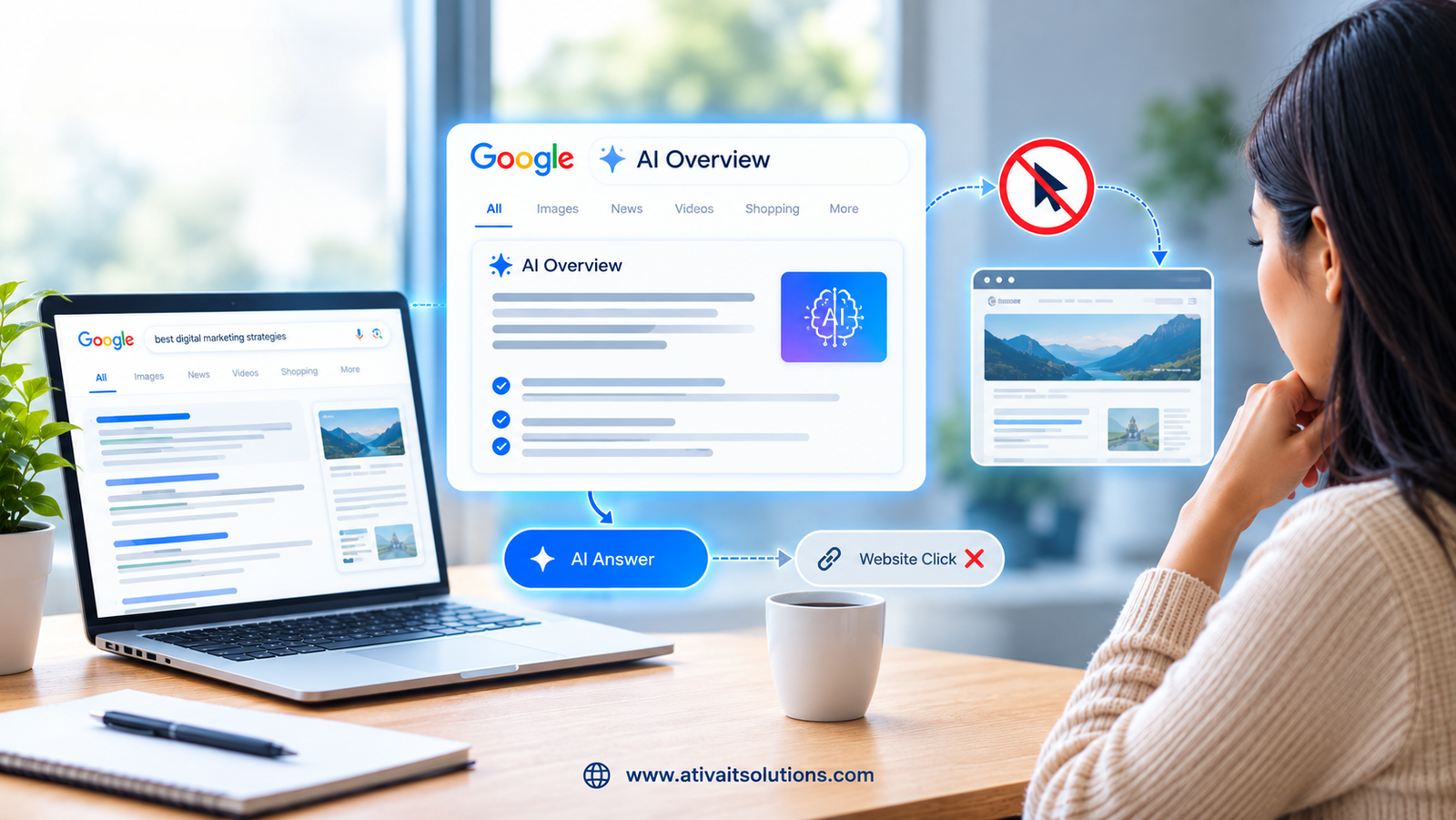




Google AI Search- If Google answers the question directly, will people still click on websites?
New research published in August 2026 provides some interesting evidence around this question. Google is moving quickly toward AI-powered search. But a new research study raises an interesting question
What if AI Search is keeping users on Google instead of sending them to websites?
A recent study involving more than 1,000 real Google users looked at how people behaved when using traditional Google Search, Google’s AI Overviews, and AI Mode.
The findings are worth paying attention to—especially if you work in SEO or depend on organic traffic.
What did the researchers find?
The researchers conducted a seven-day field experiment with 1,100 participants whose search activity was tracked. They monitored searches, search-result pages, AI Overviews, and clicks to external websites.
Participants were exposed to different search experiences, including regular Google Search and forced AI Mode.
The results showed some interesting differences.
1. AI Search resulted in fewer website clicks
People using AI Mode were less likely to click through to external websites.
On the other hand, when AI Overviews were removed, users clicked on websites more often.
For publishers and SEO professionals, this raises an important concern: if Google provides more of the answer directly on its own results page, users may have less reason to visit the original website.
2. AI Mode didn’t necessarily make people search more
The researchers expected AI Mode might encourage people to use Google more frequently.
Instead, the AI Mode group conducted fewer search sessions.
The effect was particularly noticeable among people who were already heavy Google Search users.
3. Users reported a less satisfying search experience
Another interesting finding was related to user perception.
The study reported that AI Mode was associated with lower levels of satisfaction, usefulness, trust, and perceived relevance compared with regular search.
Interestingly, simply removing AI features didn’t appear to significantly change how users perceived Google Search.
What does this mean for SEO?
This doesn’t mean that Google AI Search is automatically “bad” or that traditional SEO is dead.
But it does highlight a major shift:
Ranking in Google may no longer be enough to guarantee a visit to your website-
If users can get an answer directly from an AI-generated result, the traditional journey—
Search → Click → Website → Read
could increasingly become:
Search → AI Answer → End
That creates a very different challenge for publishers, businesses, and SEO professionals.
The bigger question now isn’t just:
How do I rank on Google?
It’s also:
How do I make my brand visible and valuable when users don’t necessarily click?
And that’s where strategies around brand visibility, authoritative content, citations, structured information, and visibility across AI search experiences become increasingly important.
One important point: this was a specific seven-day experimental study, so its findings shouldn’t automatically be treated as a complete picture of every Google user’s behavior.
What Should Businesses Do Now?
There is no need to completely abandon traditional SEO.
Instead, businesses can start preparing for a search environment where users may interact with AI-generated answers before they ever reach a website.
That means continuing to invest in technical SEO and quality content while also building strong brand signals, useful resources and first-hand expertise.The goal shouldn’t simply be to chase every new Google feature.
The goal should be to create content and a brand that people have a reason to look for, trust and engage with.
Google AI Search is changing the way information is discovered online.
The latest research adds evidence to an important discussion: AI-powered search can reduce the number of users who click through to external websites.
For publishers and businesses that depend heavily on search traffic, this is something worth watching closely.
But AI Search doesn’t make SEO irrelevant.
It changes the game.
The future may belong less to websites that simply rank for keywords and more to brands that can build visibility, authority and trust across the entire search experience.
Frequently Asked Questions About Google AI Search
1. What is Google AI Search?
Google AI Search refers to Google’s AI-powered search features, including AI Overviews and AI Mode, which use artificial intelligence to provide more direct answers to users within the search experience.
2. Does Google AI Search reduce website traffic?
Recent experimental research found that users exposed to AI-powered search were less likely to click through to external websites. However, the impact can vary depending on the type of search, industry, content and user intent.
3. What is Google AI Mode?
Google AI Mode is an AI-powered search experience that allows users to interact with Google using more conversational and detailed queries. Instead of relying only on traditional search results, users can receive AI-generated responses and continue exploring a topic within the AI experience.
4. What are Google AI Overviews?
Google AI Overviews are AI-generated summaries that can appear at the top of certain Google Search results. They provide users with a quick overview of a topic and may include links to supporting websites.
5. Is Google AI Search replacing traditional SEO?
No. Traditional SEO is still important for helping websites become discoverable in search. However, Google AI Search is changing how users interact with search results, so businesses may need to think beyond rankings and focus on visibility, authority and brand recognition.
6. How does Google AI Search affect SEO?
Google AI Search can affect SEO by changing how often users click traditional search results. Businesses may need to focus not only on rankings but also on creating original, useful and authoritative content that can stand out in an AI-driven search environment.
7. Will AI Search reduce clicks to websites?
Research suggests that AI-powered search can reduce clicks to external websites because users may find enough information directly within Google’s search experience. The effect is not necessarily the same for every query or website.
8. What should businesses do about Google AI Search?
Businesses should continue investing in technical SEO, useful content and website experience while also building strong brand authority and original expertise. Creating content that provides genuine value beyond a basic AI-generated answer can help businesses remain relevant as search evolves.
9. Is Google AI Search good or bad for users?
The answer can depend on the searcher’s needs. AI Search may make some information easier to access, while the 2026 field study found lower satisfaction and trust among participants exposed to AI Mode. More research will be useful as Google’s AI search features continue to evolve.
10. What does Google AI Search mean for the future of SEO?
Google AI Search suggests that SEO is moving beyond simply ranking pages for keywords. Businesses may increasingly need to focus on being visible, credible and useful throughout the entire search journey—including experiences where users may receive an answer without visiting a website.
Additional Coverage: Search Engine Journal — Research Shows Google AI Mode Sends Less Clicks & Is A Poor User Experience.