What Is Amazon DSP and How Should eCommerce Brands Use It?
Amazon DSP (Demand-Side Platform) is Amazon’s programmatic advertising system for buying display, video, audio, and streaming TV ads at scale. Instead of bidding on keywords, brands use Amazon DSP to reach shoppers based on real purchase behavior, browsing history, and category interest, on Amazon.com and across thousands of third-party sites, apps, and streaming platforms.
If you sell on Amazon and have already scaled Sponsored Products and Sponsored Brands, Amazon DSP is usually the next lever. It doesn’t replace search advertising, it extends it, reaching shoppers before they start searching instead of only competing for clicks once they do.
This guide breaks down what Amazon DSP actually is, how it differs from Sponsored Ads, what it costs, the different ways to access it, and how eCommerce brands should think about using it.
What Is Amazon DSP?
Amazon DSP is a self-serve and managed advertising platform that lets advertisers programmatically buy media across Amazon’s own properties and its third-party publisher network. What sets it apart from a typical display network is the data behind the targeting: Amazon DSP runs on first-party shopper signals, actual purchases, product views, and category browsing, rather than modeled demographics pulled from cookies or surveys.
It’s also open to non-endemic advertisers. Brands that don’t sell a single product on Amazon, think insurance, financial services, travel, or automotive companies, can still use Amazon DSP to reach Amazon’s audience with their own campaigns.
How Amazon DSP Works
Amazon DSP campaigns run on a CPM basis, meaning you pay per thousand impressions rather than per click. That pricing model reflects the job DSP is built for: building reach and frequency across a defined audience, not competing for individual search terms.
Targeting works in layers:
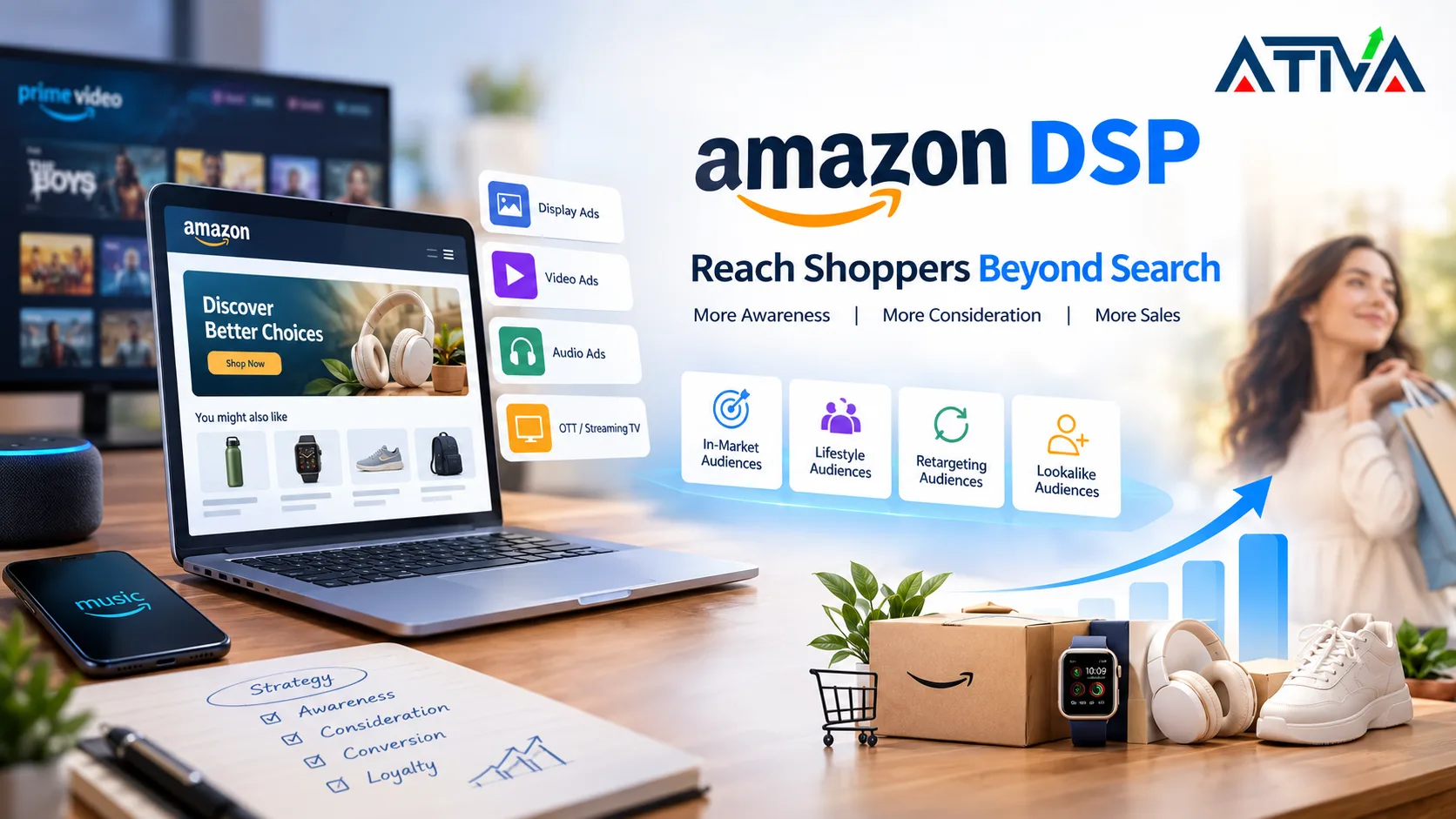
- In-market audiences — shoppers actively browsing or buying in a category
- Lifestyle audiences — grouped by behavior, like home cooks or fitness buyers
- Retargeting audiences — shoppers who viewed a product page or abandoned a cart
- Lookalike audiences — new prospects who resemble your existing customers
Placements are just as flexible. A single DSP buy can run across Amazon.com, IMDb, Twitch, Fire TV, Amazon Music, and third-party publisher inventory, spanning display, video, audio, and streaming TV formats.
Amazon DSP vs. Sponsored Ads
The two aren’t competing options, they solve different problems in the funnel.
| Amazon DSP | Sponsored Ads (Search) | |
|---|---|---|
| Targeting | Behavior, demographics, interests | Keywords and search queries |
| Placement | Amazon, third-party sites, apps, streaming | Amazon search results and product pages |
| Ad formats | Display, video, audio, OTT | Sponsored Products, Brands, Display |
| Funnel role | Full-funnel: awareness to loyalty | Mostly bottom-of-funnel conversion |
| Reach | On and off Amazon | Amazon only |
Sponsored Ads catch demand that already exists. Amazon DSP creates it, by putting your brand in front of shoppers before they’ve typed a single search term.
Amazon DSP vs. Sponsored Display
Sponsored Display is one of the three Sponsored Ads types, but it’s not the same tool as DSP. The biggest difference is eligibility: Sponsored Display is endemic-only, while Amazon DSP is open to any brand, selling on Amazon or not.
| Amazon DSP | Sponsored Display | |
|---|---|---|
| Eligibility | Endemic + non-endemic | Endemic only |
| Cost structure | CPM | PPC |
| Creative control | Fully customizable | Auto-generated, limited |
| Audience targeting | Custom audiences via AMC + Amazon data | Product targeting, views remarketing |
If you need full creative control or you’re not selling on Amazon at all, DSP is the only route between the two.
The 5 Ways Into Amazon DSP
This is the part most guides skip, and it’s often the deciding factor for smaller and mid-sized brands: how you actually get access to Amazon DSP changes both the cost and the level of control you get.
- Direct with Amazon. Your own seat, managed or self-service. Minimum spend typically runs $35,000–$50,000 a month, often with a three-month commitment. Amazon generally only onboards brands here once they’re already spending heavily on PPC.
- Through an agency’s seat. The agency adds you as an advertiser inside their own seat. No minimum spend, but you run on their reporting cadence and priorities. Ask for read access to your own data.
- A tech partner. Platforms like Pacvue, Perpetua, Intentwise, and Quartile lower the barrier to entry and add campaign tooling on top, usually for a minimum fee plus a percentage of spend.
- Advertiser rental (hybrid). A seat holder spins up a dedicated advertiser instance and hands you direct control, for a flat fee or a percentage of spend.
- Test accounts. A real, spend-capped account for learning the interface and audience tools before committing budget.
One thing worth knowing before you pick a route: Amazon Marketing Cloud (AMC) access sits at the seat level, not the advertiser level. If AMC’s cross-channel attribution and custom audience building matter to your strategy, that generally means you need your own seat rather than a shared one.
How Amazon DSP Maps to the Funnel
Most Amazon sellers start at the bottom, Sponsored Products for conversions, Sponsored Brands for search visibility. Both work, and both get more expensive as competition for the same queries grows. DSP gives you an entry point earlier in the journey:
- Awareness — Reach shoppers who fit your category but haven’t engaged with your brand. Measured by impressions, reach, and detail page view rate.
- Consideration — Target in-market shoppers browsing competitor products. Measured by detail page views, click-through rate, and new-to-brand metrics.
- Conversion — Retarget shoppers who viewed a product or abandoned a cart. Measured by ROAS, purchase rate, and cost per acquisition.
- Loyalty — Drive repeat purchases and Subscribe & Save adoption among existing buyers. Measured by repeat purchase rate and lifetime value.
The strongest results come from treating these as connected stages, where upper-funnel spend builds the audience pool that retargeting later converts, rather than running each in isolation.
Amazon DSP Ad Formats
- Display ads — Static or dynamic banners, strong for retargeting and category prospecting.
- Video ads — In-stream and out-stream video on Amazon-owned sites and third-party publishers, effective for storytelling and new customer acquisition.
- Audio ads — 15–30 second spots on Amazon Music and streaming audio, paired with a companion banner.
- OTT/Streaming TV ads — Non-skippable video on Fire TV and other connected TV inventory, best suited to broad top-of-funnel awareness.
What Amazon Marketing Cloud (AMC) Adds
AMC is a walled-garden analytics environment where advertisers query event-level shopper data to build attribution models, measure path-to-purchase, and see overlap between DSP, Sponsored Ads, and other channels, without ever touching personally identifiable data.
Since 2023, AMC Custom Audiences has connected that measurement directly to activation. A segment like “viewed a product three times but never purchased” can be built from an AMC query and pushed straight into a live DSP campaign as a retargeting audience.
The historical barrier here has been SQL. Several tech partners now offer no-code interfaces on top of AMC, making these audiences and reports accessible to teams without a dedicated analyst.
How Much Does Amazon DSP Cost?
Amazon DSP runs on a cost-plus model: you pay for media, plus optional fees layered on top.
- Technology fee — a percentage of media cost, set at the account level
- Audience fees — CPM-based, for using Amazon’s audience catalog
- Third-party data fees — CPM-based, when outside targeting data is added
- Managed Services fee — an added percentage of media cost if Amazon runs the campaign directly
Self-service campaigns skip the Managed Services fee and generally carry lower minimums. Specific budget minimums vary by market and by route of access (see the five ways above).
How eCommerce Brands Should Actually Use Amazon DSP
For most eCommerce brands, the practical starting point looks like this:
Get Sponsored Products and Sponsored Brands stable first-
DSP performs better when there’s already conversion data and a retargeting pool to work with.
Start with retargeting, not cold prospecting-
Shoppers who already viewed a product or added to cart convert at a materially higher rate than a cold in-market audience.
Layer in-market and lookalike audiences for growth-
Once retargeting is running cleanly, expand into category and lookalike targeting for new customer acquisition.
Measure with new-to-brand metrics, not just ROAS-
DSP’s real value is often in the delayed halo effect, campaigns influencing purchases that happen days or weeks later, which straight ROAS comparisons against search campaigns will understate.
Pick the access route that matches your spend-
A brand doing $20,000 a month in PPC has no realistic path to a direct Amazon seat. A tech partner or agency seat is usually the more practical entry point until spend justifies going direct.
FAQs About Amazon DSP
1.What’s the difference between Amazon DSP and Sponsored Ads?
Sponsored Ads target shoppers by keyword while they’re actively searching. Amazon DSP targets shoppers based on behavior and purchase history, on and off Amazon. Sponsored Ads are bottom-of-funnel; DSP spans the full funnel, and the two work best run together.
2.Does Amazon DSP require a minimum spend?
It depends on the access route. Going direct with Amazon typically requires $35,000 or more per month. Going through an agency, tech partner, or advertiser rental generally lowers or removes that minimum.
3.Can brands that don’t sell on Amazon use DSP?
Yes. Amazon DSP is open to non-endemic advertisers. Sponsored Display is not.
4.Do I need my own seat, or can I be an advertiser inside someone else’s?
It usually comes down to whether you need AMC. AMC access sits at the seat level, so a seat holder generally can’t extend full AMC access to an advertiser inside their seat without exposing other clients’ data.
5.How do I know if DSP is actually working?
Look at new-to-brand metrics and AMC attribution rather than isolated ROAS. DSP’s upper-funnel impact often shows up as purchases days or weeks after the impression, which campaign-level ROAS alone won’t capture.
Where Amazon DSP Actually Fits for eCommerce Brands
Amazon DSP isn’t a replacement for Sponsored Ads, it’s what comes after you’ve maxed out what keyword targeting alone can do. The targeting is grounded in real purchase behavior, the measurement through AMC goes deeper than search-only attribution, and the biggest variable for most brands isn’t the platform itself, it’s picking the right access route and starting with retargeting before scaling into cold audiences.