

Local SEO for Medical Practices-How to Attract More Patients in Your Area
WHY THIS MATTERS If a patient searches “doctor near me” right now — does your practice show up? In 2025, over 77% of patients use search engines before booking a healthcare appointment. Local SEO for medical practices is no longer optional; it is the single most powerful patient acquisition channel available to clinics, hospitals, and private doctors across the USA. |
Key Statistics
77% patients search online before booking | 46% of all Google searches are local intent | 3x more calls from Google Map Pack listings | 88% trust online reviews as much as referrals |
What Is Local SEO for Doctors? (And Why It’s Different)
Local SEO (Search Engine Optimization) is the practice of optimizing your online presence so nearby patients find your clinic when they search for healthcare providers in your area. Unlike general SEO, local SEO for doctors focuses on geo-targeted healthcare content, location-based search intent, and the Google Map Pack — the three top listings that appear with a map before any regular organic results.
When someone types “urgent care near me” or “family doctor in [city]”, Google uses three core signals to decide who appears: relevance, distance, and prominence. Your job is to maximize all three through a structured medical practice marketing strategy.
💡 KEY INSIGHT Patients searching with local intent are high-intent searchers — they are actively ready to book. Converting one such visitor is worth more than 100 passive blog readers from general search. |
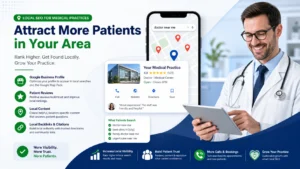
Step 1 — Claim and Optimize Your Google Business Profile
Your Google Business Profile (GBP) — formerly Google My Business — is the single most important asset in local SEO for healthcare. It controls your appearance in the Map Pack, Google Maps, and the Knowledge Panel on the right side of search results.
Complete Every Section of Your Profile
Practices with 100% complete GBP profiles receive significantly more patient actions than incomplete ones. Fill in your practice name, primary category, address, service area, phone number, website, hours, and appointment URL.
Choose the Right Categories
Your primary category is a powerful relevance signal. Choose the most specific option available — ‘Cardiologist,’ ‘Pediatrician,’ or ‘Urgent Care Center’ performs better than the generic ‘Doctor.’ Add secondary categories for additional services.
Upload High-Quality Photos Regularly
GBP listings with photos receive 42% more direction requests and 35% more click-throughs. Upload photos of your front entrance, waiting room, consultation rooms, and staff (with consent). Update monthly to signal an active profile.
GBP Optimization Checklist
- Verify your listing with a postcard or phone call
- Add all services with individual descriptions and pricing
- Enable online appointment booking directly through GBP
- Publish Google Posts weekly (health tips, offers, seasonal news)
- Respond to every patient Q&A on your profile promptly
✅ PRO TIP — GOOGLE POSTS Use Google Posts to announce seasonal health screenings, flu shot availability, or new specialist arrivals. Posts appear directly in search results and boost both visibility and local patient engagement. |
Step 2 — Optimize Your Website for Local Search
Your website is the foundation of all local SEO efforts. Every page should send clear signals to Google about who you are, where you are, and who you serve — this is the backbone of any effective medical office digital marketing strategy in the USA.
Create Dedicated Location Pages
If your practice has multiple locations, each one needs its own unique page. Include a unique facility description, embedded Google Map, local staff bios, hours, and patient testimonials specific to each location.
On-Page SEO Essentials
Incorporate target keywords naturally into page titles, H1 headings, meta descriptions, image alt texts, and body content. Include LSI terms like ‘nearby medical clinic search,’ ‘healthcare providers in your area,’ and ‘online appointment booking’ naturally.
Mobile-First Optimization
Over 60% of ‘doctor near me’ searches happen on smartphones. Ensure your site loads in under 3 seconds, buttons are touch-friendly, forms are easy to complete, and your phone number is a clickable tap-to-call link.
Implement LocalBusiness Schema Markup
Add MedicalOrganization or Physician schema to declare your specialty, address, phone, hours, and accepted insurance — this can directly improve your appearance in rich search results.
Key On-Page SEO Actions
01 Title Tag Optimization Include primary keyword + city. E.g., ‘Cardiologist in Austin, TX | Heart Health Clinic’ | 02 NAP Consistency Name, Address, Phone must match exactly across your site and all directories |
03 Page Speed Aim for Core Web Vitals pass. Compress images, minify CSS/JS, use lazy loading | 04 Internal Linking Link service pages to location pages. Help Google map your site architecture |
Step 3 — Build Citations in Healthcare Directories
Citations are online mentions of your practice’s Name, Address, and Phone number (NAP). Consistent citations across authoritative healthcare directories are a core ranking signal for local search. Even small inconsistencies — ‘St.’ vs ‘Street’ — can dilute your authority.
Priority Healthcare Directories
- Healthgrades — the most visited doctor review site in the USA
- Zocdoc — direct patient booking platform with strong SEO domain authority
- WebMD Doctor Directory — high trust and domain authority signal
- com — widely indexed by Google for local searches
- RateMDs — influential in patient decision-making
- Yelp for Business — critical for urgent care and walk-in clinics
- Bing Places for Business — valuable for Bing/Cortana search users
- Apple Maps — essential for iPhone users searching locally
⚠️ WATCH OUT Duplicate listings on the same directory can severely harm your local rankings. Audit and consolidate duplicates on Healthgrades, Zocdoc, and Yelp before building new citations. |
Step 4 — Generate and Manage Patient Reviews
Patient reviews and ratings are among the most powerful trust signals in healthcare. Google explicitly uses review quantity, quality, and recency in its local ranking algorithm. 84% of patients say online reviews influence their choice of provider.
How to Ethically Request Reviews (HIPAA-Compliant)
Ask patients for reviews after a positive appointment. Use a follow-up email or SMS with a direct link to your Google review page. Never disclose their health condition. Never offer incentives — it violates Google’s policies and FTC guidelines.
Respond to Every Review
Thank positive reviewers warmly. For negative reviews, acknowledge professionally without confirming or denying any specific healthcare detail (HIPAA compliance). Invite them to call your office directly to resolve the issue.
📊 STRATEGY TIP Aim for 15+ Google reviews with an average of 4.2 stars or above to become competitive in most local markets. Practices with 50+ reviews see a measurable jump in Map Pack click-through rates. |
Step 5 — Create Geo-Targeted Healthcare Content
Content marketing amplifies every other element of your local SEO strategy. By publishing high-quality, location-specific health content, you capture long-tail search traffic from patients researching symptoms, conditions, and local specialists.
Content Ideas That Drive Local Patient Traffic
- “Best Cardiologist in [City]: What to Look for in a Heart Specialist”
- “When to Visit Urgent Care vs Emergency Room in [State]”
- “[City] Health Guide: Managing Diabetes in the Southeast”
- “New Patient Guide: What to Expect at [Practice Name]”
- “Top 5 Questions to Ask Your Primary Care Physician in [City]”
- Seasonal health tips tied to your local region (allergy season, heat safety)
Target ‘Near Me’ and Voice Search Queries
Create an FAQ section that directly answers common voice search phrases like ‘What are the best-rated doctors near me?’ or ‘Which clinics accept walk-ins in [city]?’ — targeting the full spectrum of urgent care near me searches.
Step 6 — Build Local Backlinks for Healthcare Authority
Backlinks remain one of Google’s most powerful ranking signals. For local SEO services for healthcare, the quality and local relevance of backlinks matters far more than quantity.
- Local Chamber of Commerce membership listings and event pages
- County or city health department resource and referral pages
- Local news outlets covering community health topics
- Hospital or health system partner and affiliate pages
- Sponsorship of local health fairs and community wellness events
- Medical school affiliations and residency program pages
- Insurance provider network directories listing participating physicians
📋 EXPERT INSIGHT A single backlink from your county health department’s website can outweigh dozens of links from generic directories. Focus on genuinely local, authoritative sources over bulk link-building tactics. |
HIPAA Compliance in Your Digital Marketing Strategy
Every medical practice in the USA operating a digital marketing program must maintain HIPAA-compliant marketing practices throughout. This affects review responses, email campaigns, remarketing ads, and any use of patient data.
- Never include patient names, conditions, or identifiers in review responses
- Use a HIPAA-compliant contact form on your website (avoid standard Google Forms for PHI)
- If running Google Ads or Meta Ads, work with a HIPAA-trained marketing professional
- Have a Business Associate Agreement (BAA) with any vendor who accesses patient data
- Maintain an up-to-date Privacy Policy and Notice of Privacy Practices on your website
Your Local SEO Action Plan-
Six pillars to dominate local search for your medical practice:
01 Google Business Profile Claim, verify, complete 100%, and post weekly updates | 02 Website Optimization Location pages, schema markup, mobile-first, fast loading |
03 Citations & Directories Consistent NAP on Healthgrades, Zocdoc, WebMD, Yelp | 04 Review Management Request ethically, respond to all, monitor monthly |
05 Local Content Geo-targeted blogs, FAQs, seasonal health guides | 06 Local Backlinks Chamber, health dept, local news, community events |
READY TO DOMINATE LOCAL SEARCH? Local SEO is a long-term investment that pays compounding returns. Every optimized citation, every earned review, and every piece of geo-targeted content brings more patients to your practice — 24 hours a day, without paying for every click. Start with your Google Business Profile today. It’s free, powerful, and the fastest first step any medical practice can take. |
About the Author
Healthcare Content Team
Specialized in medical practice marketing, local SEO strategy for healthcare providers, and HIPAA-compliant digital marketing across the USA. This guide is reviewed and updated regularly to reflect the latest Google algorithm changes and healthcare marketing best practices.